

Python’s simplicity and robust libraries empower effective data analysis, especially when combined with PDF document processing capabilities, offering a streamlined workflow for insights.
What is Data Analysis with Python?
Data analysis with Python involves leveraging the language’s powerful ecosystem of libraries to examine, clean, transform, and model data. It’s a process of inspecting, cleaning, transforming, and modeling data with the goal of discovering useful information, drawing conclusions, and supporting decision-making; Python’s ease of learning and extensive collection of tools make it ideal for both beginners and experienced analysts.
Specifically, when dealing with PDF documents, Python facilitates extracting valuable data embedded within these files. This often involves utilizing libraries to parse the PDF structure and retrieve text, tables, and other relevant information. The extracted data can then be integrated into standard data analysis workflows, enabling insights from previously inaccessible sources. This combination unlocks powerful capabilities for businesses and researchers alike.
Why Use Python for Data Analysis?
Python excels in data analysis due to its simple syntax, extensive libraries, and a large, supportive community. Libraries like NumPy, Pandas, and Matplotlib provide efficient data manipulation, analysis, and visualization capabilities. Python’s ability to handle large datasets and perform complex calculations makes it a preferred choice for data scientists.
Furthermore, Python’s versatility extends to handling PDF files. Libraries such as PDFMiner and PyPDF2 allow for seamless extraction of data from PDF documents, enabling integration with broader analytical workflows. This is crucial as much valuable information resides within PDF reports, research papers, and other document formats. Python bridges the gap, transforming static PDF content into actionable data for informed decision-making.
Core Python Libraries for Data Analysis
NumPy, Pandas, and Matplotlib form the bedrock of Python data analysis, providing tools for numerical computation, data manipulation, and insightful visualizations.
NumPy: Numerical Computing
NumPy, the fundamental package for numerical computation in Python, provides support for large, multi-dimensional arrays and matrices, alongside a collection of high-level mathematical functions to operate on these arrays. Its efficiency stems from optimized C code under the hood, making it significantly faster than standard Python lists for numerical operations.
For data analysis involving PDFs, NumPy becomes crucial when dealing with the numerical data extracted from tables or charts within those documents. It allows for efficient storage and manipulation of this data, enabling calculations, statistical analysis, and transformations. NumPy’s broadcasting feature simplifies operations between arrays of different shapes, and its random number generation capabilities are valuable for simulations and modeling. Furthermore, NumPy integrates seamlessly with other core data science libraries like Pandas and Matplotlib, forming a powerful ecosystem for comprehensive data analysis workflows.
Pandas: Data Manipulation and Analysis
Pandas is a powerful Python library designed for data manipulation and analysis, offering data structures like DataFrames – tabular data with labeled rows and columns – that simplify data handling. It excels at cleaning, transforming, and analyzing data, providing intuitive methods for filtering, grouping, merging, and reshaping datasets.
When working with data extracted from PDFs, Pandas becomes indispensable. Text extracted using libraries like PDFMiner or PyPDF2 can be easily loaded into a Pandas DataFrame, allowing for structured analysis. Pandas handles missing data gracefully, and its built-in functions facilitate data cleaning and preprocessing. The library’s ability to perform complex aggregations and calculations makes it ideal for deriving insights from PDF-sourced data, ultimately supporting informed decision-making processes. Pandas integrates seamlessly with NumPy and Matplotlib, enhancing the overall data analysis pipeline.
Matplotlib: Data Visualization
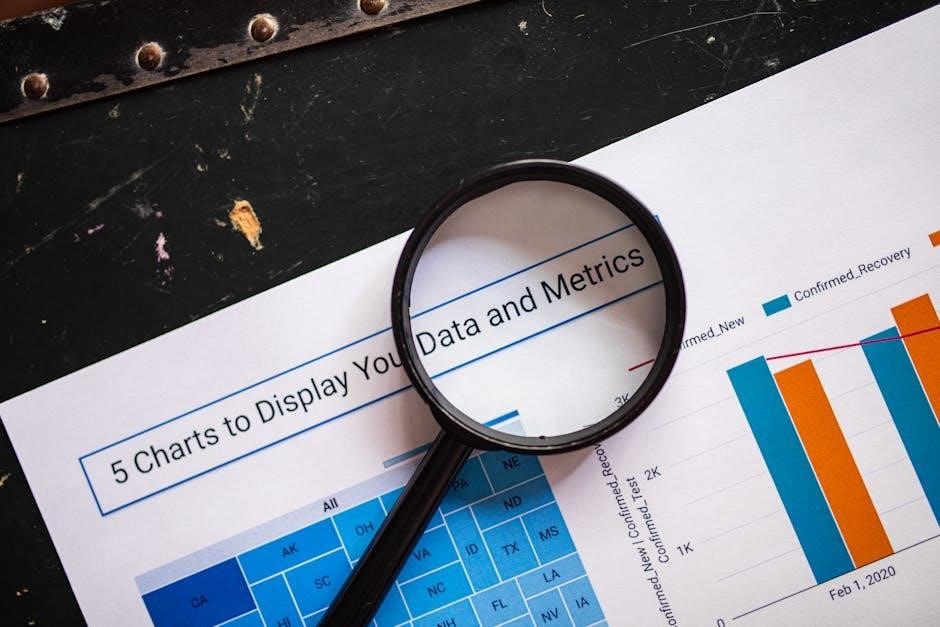
Matplotlib is a foundational Python library for creating static, interactive, and animated visualizations in Python. After extracting and analyzing data from PDFs using libraries like Pandas, Matplotlib allows you to present your findings visually, making complex data more accessible and understandable. It offers a wide range of plot types – line plots, scatter plots, bar charts, histograms, and more – enabling you to choose the most effective visualization for your data.
When dealing with data sourced from PDFs, clear visualizations are crucial for identifying trends and patterns. Matplotlib’s customization options allow you to tailor plots to your specific needs, including labels, titles, legends, and color schemes. Combining Matplotlib with Pandas streamlines the process of visualizing PDF-derived data, facilitating data-driven storytelling and effective communication of analytical results. Strong visualizations are key to communicating data analysis effectively.

Working with PDF Files in Python
Python offers powerful libraries – PDFMiner, PyPDF2, and ReportLab – to extract, manipulate, and create PDF documents, essential for comprehensive data analysis workflows.
PDFMiner: Extracting Text from PDFs
PDFMiner is a crucial Python library specifically designed for extracting text content from PDF documents. It’s a powerful tool when dealing with data locked within PDF formats, enabling its use in subsequent analysis. Unlike simple text extraction methods, PDFMiner attempts to logically order the text, preserving document structure as much as possible.
The library operates by first parsing the PDF file to identify text elements, fonts, and layout information. It then reconstructs the text, offering options to handle complex layouts, including columns and tables. Developers can customize the extraction process to suit specific PDF structures, improving accuracy and relevance.
PDFMiner’s flexibility makes it ideal for various applications, such as data mining, information retrieval, and automated report generation. It’s particularly useful when dealing with scanned documents or PDFs generated from diverse sources, providing a robust solution for unlocking valuable data.
PyPDF2: Manipulating PDF Files
PyPDF2 is a versatile Python library focused on manipulating PDF files, going beyond simple text extraction. It allows developers to split, merge, crop, and transform PDF documents programmatically, offering a wide range of functionalities for data preparation and analysis.
Key features include the ability to rotate pages, insert new pages, encrypt and decrypt PDFs, and extract metadata. This makes PyPDF2 invaluable for tasks like combining reports, redacting sensitive information, or preparing documents for specific analytical workflows. It’s particularly useful when needing to restructure PDF content before extracting data.
While primarily a manipulation tool, PyPDF2 can also extract text, though it’s generally less sophisticated than PDFMiner in handling complex layouts. Its strength lies in its ability to modify PDF structure, making it a powerful complement to other data analysis tools.
ReportLab: Creating PDF Documents
ReportLab empowers Python developers to generate complex PDF documents directly from their code, offering precise control over layout and content. Unlike libraries focused on extracting from PDFs, ReportLab is dedicated to creating them, making it ideal for presenting data analysis results in a professional, formatted manner.
This library allows for the dynamic creation of reports, charts, tables, and text, all within a PDF framework. Developers can define precise positioning, fonts, colors, and images, ensuring consistent branding and presentation. It’s particularly useful for automating report generation based on data analysis outputs.
ReportLab supports various PDF features, including bookmarks, outlines, and encryption. It’s a robust solution for building customized PDF reports directly integrated with Python data analysis pipelines, offering a complete end-to-end solution.

Data Analysis Workflow with Python and PDFs
Python facilitates a seamless workflow: extracting data from PDFs, cleaning it with Pandas, performing analysis, and visualizing insights for informed decision-making.
Loading Data from PDFs into Pandas DataFrames
Successfully integrating PDF data into a Pandas DataFrame is a crucial first step. Utilizing libraries like PDFMiner or PyPDF2, text is extracted from PDF documents. This extracted text often requires cleaning – removing unwanted characters, handling line breaks, and structuring the data appropriately.
Once cleaned, the text can be parsed and organized into a tabular format suitable for a DataFrame; Regular expressions are frequently employed to identify patterns and separate data into columns. Consider the PDF’s structure; table-like data benefits from specialized parsing techniques.
The resulting DataFrame allows for powerful data manipulation and analysis using Pandas’ extensive functionality. Careful consideration of encoding and potential errors during extraction is vital for data integrity. This process transforms unstructured PDF content into a structured, analyzable format.
Data Cleaning and Preprocessing
After loading data from PDFs, cleaning and preprocessing are essential for accurate analysis. This involves handling missing values, correcting inconsistencies, and transforming data into a usable format. Common tasks include removing irrelevant characters, standardizing text case, and correcting spelling errors extracted from PDFs.
Data type conversion is also critical; ensuring numerical values are correctly identified as integers or floats. Dealing with inconsistent formatting within the PDF data—dates, currencies, or units—requires standardization. Outlier detection and removal can improve model performance.
Preprocessing might involve tokenization, stemming, or lemmatization for text analysis. These steps prepare the data for effective exploration and modeling, maximizing the value derived from the initially unstructured PDF content.
Exploratory Data Analysis (EDA)
Following data cleaning, Exploratory Data Analysis (EDA) unveils patterns, trends, and relationships within the data extracted from PDFs. Utilizing Pandas and Matplotlib, EDA involves summarizing data through descriptive statistics – mean, median, standard deviation – and visualizing distributions using histograms and box plots.

Correlation analysis identifies relationships between variables, while scatter plots reveal potential dependencies. For textual data from PDFs, word frequency analysis and sentiment analysis provide valuable insights. Grouping and aggregation techniques help summarize data across different categories.
EDA is an iterative process, guiding further investigation and hypothesis generation. It’s crucial for understanding the data’s characteristics and informing subsequent modeling or decision-making processes, ultimately maximizing the value of the PDF-sourced information.

Advanced Visualization Techniques
Beyond Matplotlib, Bokeh, Holoviews, Altair, and Plotly offer interactive and web-based visualizations, enhancing data exploration from PDF analysis.
Bokeh: Interactive Web Plots
Bokeh empowers the creation of interactive web-based visualizations, ideal for exploring complex datasets extracted from PDF documents during data analysis. Unlike static plots, Bokeh allows users to zoom, pan, and hover over data points, revealing deeper insights. This library excels at handling large streaming or real-time datasets, making it suitable for dynamic PDF-derived information.
Its focus on modern web browsers means visualizations are readily shareable and accessible without requiring specialized software. Bokeh’s flexibility extends to creating dashboards and applications, integrating seamlessly with other Python data science tools. The library supports a wide range of plot types, from simple scatter plots to complex network graphs, all customizable to effectively communicate findings from PDF data. Furthermore, Bokeh’s interactive features enhance data storytelling and facilitate collaborative analysis.
Holoviews: Declarative Visualization
Holoviews simplifies data visualization by adopting a declarative approach, allowing analysts to focus on what they want to visualize rather than how. This is particularly beneficial when working with data extracted from PDFs, as it streamlines the process of creating insightful plots. Instead of manually specifying plot details, you define the data and desired visual representation, and Holoviews handles the rest.
It builds upon Bokeh and Matplotlib, offering a higher-level interface for creating complex visualizations with minimal code. Holoviews excels at multi-dimensional data exploration, making it ideal for analyzing datasets derived from tabular data within PDFs. Its seamless integration with other Python libraries, like Pandas, facilitates a smooth data analysis workflow. The library’s composability allows for building sophisticated visualizations by combining multiple plots and datasets, enhancing the understanding of PDF-sourced information.
Altair: Statistical Visualization
Altair is a declarative statistical visualization library for Python, built on Vega and Vega-Lite. It’s exceptionally well-suited for creating a wide range of effective and aesthetically pleasing charts from data extracted from PDF documents. Altair’s strength lies in its ability to express visualizations concisely, focusing on the relationships between variables rather than low-level plotting details.
When analyzing data sourced from PDFs, Altair simplifies the creation of statistical graphics like histograms, scatter plots, and box plots, aiding in exploratory data analysis (EDA). Its declarative syntax promotes reproducibility and makes visualizations easily shareable. Altair seamlessly integrates with Pandas DataFrames, allowing direct visualization of data loaded from PDFs. The library’s emphasis on best practices in visual encoding ensures that insights are communicated clearly and accurately, enhancing data-driven decision-making.
Plotly: Interactive and Web-Based Plots
Plotly is a powerful Python library for creating interactive, web-based visualizations, ideal for exploring data extracted from PDF files. It allows for the generation of dynamic charts, graphs, and maps that can be easily shared and embedded in web applications or dashboards. Plotly’s interactivity—zooming, panning, and hovering—enhances data exploration, revealing patterns often missed in static plots.
When working with data loaded from PDFs into Pandas DataFrames, Plotly provides a versatile toolkit for creating compelling visualizations. Its support for various chart types, including 3D plots and contour plots, enables complex data relationships to be visualized effectively. Plotly’s ability to create offline and online plots makes it suitable for both individual analysis and collaborative projects, facilitating data-driven insights from PDF-sourced information.

Practical Applications and Real-World Examples
Python and PDF data analysis unlock insights across sectors like retail and healthcare, improving decision-making through data-driven strategies and efficient processing.
Data Analysis in Retail

Python excels in retail data analysis, particularly when extracting information from PDF reports like sales figures, inventory lists, and customer feedback surveys. Utilizing libraries like Pandas, retailers can efficiently load this data into structured formats for analysis. This enables tracking key performance indicators (KPIs) such as sales trends, customer purchasing patterns, and inventory turnover rates.
PDFMiner or PyPDF2 can automate the extraction of data from numerous PDF documents, saving significant time and reducing manual errors. Advanced techniques, coupled with Matplotlib or Plotly, allow for the creation of compelling visualizations to identify opportunities for optimization. For example, analyzing sales data can reveal popular product combinations, informing targeted marketing campaigns and product placement strategies. Furthermore, sentiment analysis of customer feedback extracted from PDF surveys can provide valuable insights into customer satisfaction and areas for improvement.
Data Analysis in Healthcare
Python offers powerful tools for healthcare data analysis, frequently involving the processing of information stored in PDF formats like patient records, clinical trial reports, and insurance claims. Libraries such as Pandas facilitate the organization and manipulation of this data, enabling researchers and healthcare professionals to identify trends and patterns.
Extracting data from PDF documents using PDFMiner or PyPDF2 allows for automated analysis of large datasets, improving efficiency and accuracy. This can support tasks like identifying risk factors for diseases, evaluating the effectiveness of treatments, and optimizing resource allocation. Visualizations created with Matplotlib or Plotly can effectively communicate complex findings to stakeholders. Analyzing patient data extracted from PDF reports can also help predict patient outcomes and personalize treatment plans, ultimately improving patient care and overall healthcare system performance.

Resources and Further Learning
Explore online tutorials, comprehensive courses, and detailed documentation to deepen your understanding of Python for data analysis and PDF handling techniques.
Online Tutorials and Courses
Numerous platforms offer excellent resources for mastering data analysis with Python and PDF manipulation. FreeCodeCamp provides a comprehensive tutorial, readily available as a PDF for offline access, covering foundational concepts and practical applications.
For structured learning, platforms like Coursera, Udemy, and DataCamp host specialized courses. These often feature hands-on projects, guiding you through real-world scenarios involving data extraction from PDFs using libraries like PDFMiner and PyPDF2, followed by analysis with Pandas and visualization with Matplotlib.
YouTube channels dedicated to Python programming and data science also provide valuable, often free, content. Look for tutorials specifically addressing PDF text extraction and data cleaning techniques. Supplement these with official documentation for libraries like ReportLab when creating PDF reports from your analyses.
Books and Documentation
Several books provide in-depth knowledge of data analysis with Python, often including sections on handling document formats like PDFs. Titles focusing on data mining, such as Richard J. Roiger’s “Data Mining: A Tutorial-Based Primer,” offer foundational understanding. Explore resources covering object-oriented approaches to data clustering for advanced techniques.
Crucially, the official documentation for Python libraries is invaluable. The Pandas documentation details DataFrame manipulation, while Matplotlib’s documentation showcases visualization options. For PDF-specific tasks, consult the PDFMiner and PyPDF2 documentation to understand their functionalities for text extraction and file manipulation.
ReportLab’s documentation is essential when generating PDF reports. These resources provide detailed explanations, examples, and API references, enabling efficient and accurate implementation of your data analysis workflows.